
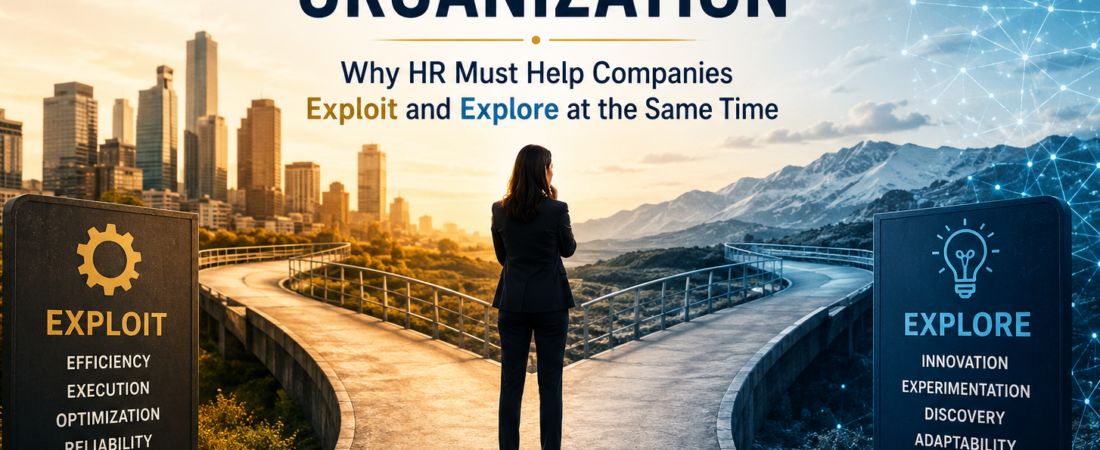
First, I have to address my absence for the past 2 or 3 weeks. My duty travel took me to the other side of the globe and back and, jet lag, long meetings, and the need to just show up were strong adversaries to my settling down to write in the Corner Office. But sometimes absence makes the heart grow fonder and I hope that this is the case for you dear readers.
So now that my apologies are out of the way, let me get into this week.
A long time ago, I shared with the readers in the Corner Office that I try to learn something new every year or at least earn a new certification.
Last year it was a Compensation & Benefits certification. This decided to delve into the curious but fascinating world of organizational design. Thanks to eCornell’s partnership with Humentum (more on that later) I was able to once again sign up for their online certification from. It is grueling mind you, especially if you are trying to get it done after work when you are already bushed. But completely worth it. If you haven’t browsed eCornell’s offerings ever, I encourage you to visit their website.
But I digress. I really want to share this week about one of the concepts which I came across in one of the courses which resonated with me, mostly because I have been promoting it for a while without necessarily having named it. You see, while working through a module on organizational growth strategies, I came across the concept of the ambidextrous organization. And that dear readers is going to be subject of this week’s Corner Office.
Most organizations, particularly during periods of uncertainty, are naturally drawn toward one end of the spectrum or the other. When resources become constrained, when funding pressures emerge, or when leaders face increasing demands for accountability, the instinct is often to tighten controls, standardize processes, stick to what works and focus on implementation. Makes sense doesn’t it? In the face of all of this, organizations go to survival mood and they survive because commitments are met, clients are happy because their needs are met, projects are delivered, and resources are managed responsibly.
But this approach, while it works in the present, can be dangerous for the future. The organization becomes comfortable once the current model keeps working and there is either an unspoken hope that things will return to the “good ole’ days” or an assumption that the future will resemble the past. I have said over and over again in this blog that change is the only constant so it would be foolish to assume that things will stay the same and if things are constantly changing, the result will be that the very systems that created efficiencies have also been silently creating rigidity.
In this context, experimentation, innovation and risk-taking starts to feel disruptive rather than valuable. New ideas are evaluated through the lens of existing structures rather than future opportunities and organizations will gradually find themselves investing more energy in protecting what already exists than in imagining what might come next.
At the same time, the opposite pattern can be equally problematic. The pandemic and post-pandemic era coupled with millennials entering the workforce brought with it the fad of celebrating disruption, transformation, innovation, and agility. Emerging leaders were encouraged to challenge assumptions, embrace uncertainty, and continually reinvent their organizations. Yet transformation is not inherently valuable simply because it is new.
“Once upon a time, office trends like installing a ping pong table in the office was seen as the ultimate sign of a ‘progressive’ workplace.” ~ Plants, Perks & Ping Pong. Which office trends have stood the test of time?, Kerr Office Group, LinkedIn, November 2025.
I remember a time when office spaces were being redesigned to be more “cool” and to stir your creative juices. Organizations in that era were so captivated by innovation that they struggled to sustain focus. New initiatives were either things brought back from the past or they appeared before other “new” initiatives had even been completed. Strategic priorities shifted so frequently that employees found it difficult to understand what truly mattered. There was a plethora of new and pilot projects, all promising to unlock future value. People often described themselves as multi-taskers, creatives and innovators, but what they were really experiencing was fragmentation. Innovation without execution can be every bit as dangerous as execution without innovation because eventually an organization must convert ideas into results if it wishes to remain viable.
Therein lies my fascination with the concept of the ambidextrous organization. It marries the best of both worlds. It suggests that sustainable success depends upon maintaining both capabilities simultaneously. The organizations most likely to thrive over the long term are those that continue to refine and improve the activities that generate value today while creating space to explore opportunities that may generate value tomorrow. When viewed through this lens, things look very different.
Let’s consider for example the benefits of AI. In fact, I touched on this just a few week’s ago. Some leaders view AI primarily as a tool for improving productivity, reducing costs, and increasing efficiency. Others opine that AI may one day fundamentally reshape jobs, organizational structures, and even business models. Both perspectives are valid because one view is focused on extracting value from current operations while the other is focused on understanding how the future may evolve.
From an HR perspective, this is where the conversation becomes particularly interesting because HR sits directly at the intersection of these competing demands. Throughout my career, I have observed that many of the challenges we face in people management are really manifestations of this tension. We are expected to create consistency while accommodating local realities. We design policies intended to reduce risk while encouraging leaders to exercise judgment. We build performance systems that promote results and outcomes while simultaneously encouraging learning, development and risk-taking.
In fact, HR is often responsible for helping organizations become more ambidextrous, even if we do not always use that language. The decisions we make about organizational structure, leadership development, succession planning, talent mobility, performance management, and culture all influence how an organization can evolve. The most effective HR functions are not those that champion stability or change in isolation. Rather, they help leaders recognize that sustainable success depends upon maintaining enough of each.
What HR faces is a world where conditions change, markets evolve, technologies emerge, and organizational needs shift. So, for us the challenge is continuously adjusting as circumstances evolve because operational excellence and innovation are not opposing goals.
Perhaps the reason why the concept of the ambidextrous organization stayed with me as I was working through the module is that it offered a useful reminder that the future will belong neither to organizations that cling stubbornly to what has always worked nor to those that chase every new possibility. It will belong to organizations capable of understanding their core capabilities and strengths while remaining willing to evolve beyond them.